

How Creatives Can Manage Business Basics Without Losing Their Spark
If you have spent years building a creative career, you already know the wall. You are good at the work. The business side is another story. Freelance designers, writers, photographers, makers, and performers in their 30s, 40s, and 50s face the same tension: the work they love depends on business skills for creatives they were never taught and never really wanted to learn.
Balancing creativity and business can feel like choosing between making meaningful work and keeping the lights on, especially when mortgages, families, and a decade or two of creative career challenges are already in the mix. The hustle-harder advice does not cut it at this stage. With a steadier entrepreneurial mindset for artists, business becomes support instead of noise.

Quick Takeaways for Creative Business Basics
● Set clear pricing with simple packages to protect your time and energy.
● Use straightforward contracts and invoices to define scope, deadlines, and payment
expectations.
● Build a basic workflow that moves each project from inquiry to delivery with less stress.
● Track income and expenses lightly and regularly to stay grounded in your finances.
● Market authentically and manage your time with gentle structure so creativity stays

energized.
Understanding Business Basics Without Dulling Your Art
Business basics for creatives means getting three things clear: how you price, what your contract promises, and how you invoice and get paid. From there, you name your biggest gaps and choose a next step that fits your actual life right now, quick self-study for what you need this week, or a structured learning path for broader confidence, and you may want to check this out for an example of what a more structured learning path can look like.
This matters because fuzzy rates, vague terms, and late invoices drain energy fast and make creativity feel risky. It also helps to remember that most creative professionals were never taught this side of the work. For many Millennials and Gen Xers who built careers through instinct, referrals, and sheer persistence, the business fundamentals got patched together along the way rather than built intentionally.
Picture a designer booking a new client: they set a simple package price, use a plain contract, and send an invoice the same day. When something goes sideways, accountability gaps shrink because responsibilities are clear. With that foundation, a repeatable workflow keeps money, marketing, and time from slipping away.
Create a Weekly Business Flow That Protects Your Art
This workflow keeps your creative energy protected by giving business tasks a home on your calendar. It works because you touch money, clients, and visibility in small, regular passes, not in stressful catch-up marathons. At this stage of life and career, light but consistent is the only realistic standard.
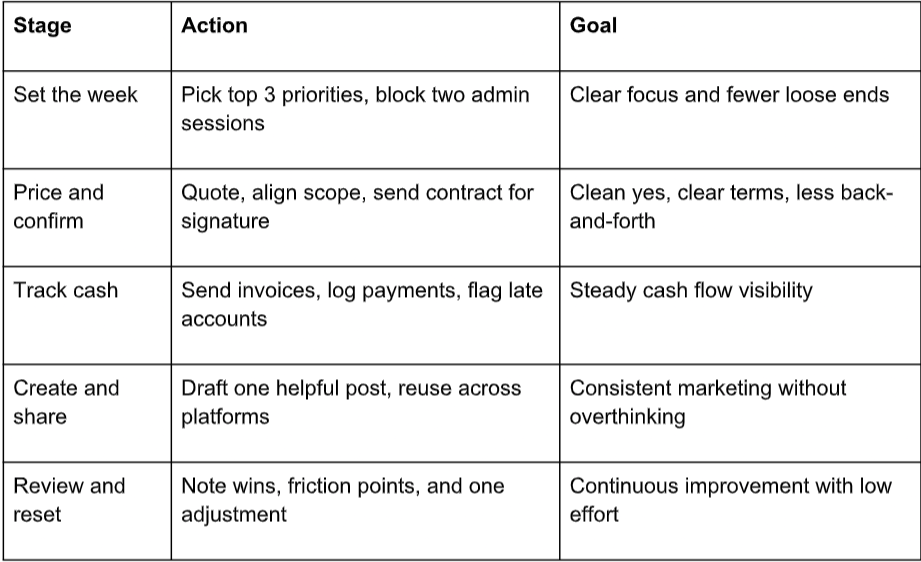
Habits That Keep Business Simple and Spark Alive
At this point in your career, the goal is not to grind harder. It is to make the business side so routine that it stops competing with the creative work you actually want to do. Tiny, repeatable habits are how that happens.
Two-Sentence Boundary Script
● What it is: Write one line for availability and one line for turnaround using set your work schedule.
● How often: Weekly review, then reuse on every new inquiry.
● Why it helps: Clear expectations reduce interruptions that drain momentum.
Deposit Before Drafting
● What it is: Require a deposit and signed scope before you start sketches or concepts.
● How often: Per project milestone.
● Why it helps: It filters shaky clients and stabilizes cash flow.
The 10-Minute Money Snapshot
● What it is: Log income, expenses, and what is still unpaid in one running note.
● How often: Twice weekly.
● Why it helps: You catch problems early, before they become panic.
One Warm Outreach
● What it is: Send one friendly check-in to a past client or collaborator.
● How often: Weekly.
● Why it helps: Light contact keeps your pipeline alive without heavy marketing.
Tiny Habit Pairing
● What it is: Use the tiny habits method by attaching admin to an existing cue.
● How often: Daily.
● Why it helps: Prompts make consistency easier than willpower.

Simple Business Basics That Protect Your Creative Energy
You have already done the hard part: building a creative career worth protecting. The steadier path forward is a simple framework: choose a few foundational business tools, keep routine business practices light and repeatable, and let adaptive business systems evolve as your needs change.
That is how starting a small business and scaling can feel like support instead of pressure, and how creative career growth stays consistent through the busy, complicated seasons of mid-career life. Keep the basics steady so your creativity can stay free. Pick one core tool to set up today, then schedule a monthly review to adjust without overhauling. Stability protects energy, builds resilience, and keeps the work sustainable for the long run.